Take your time on this one, as many times as you wish.
The first image is a model of a 1+1 dimensional spacetime, the time
axis is vertical, the x axis is horizontal, the speed of light is 1, the
orange cone is the light cone and the blue line is the world line of
any physical object. At any point on it the world line is confined to
the future (+) and past (-) of the light cone at that point, and the
point always moves forward in time.
In the second image, I've
done some "manifold surgery": I've made a cut each at t = -1 and t = +1
each of which extends from x=1 to x=3. Now I restitch them, but stitch
the bottom edge of the lower cut to the top edge of the upper cut, and
also the top edge of the lower cut is stitched to the bottom edge of the
upper cut.
Maya, Elsa and I drove to Pleasanton, from where we carpooled with Sudhir and his family to Reno. When we got to the Univ. of Nevada, the grassy are was replete with a wide variety of viewing instruments, ranging from a pinhole camera kit, through home made wooden binocular stands to 8" telescopes with motors and computerized drives. A very large number of people had shown unprepared and queued up for the solar viewing glasses that someone was selling for $10 apiece. Just for comparison, the #14 welders' glass cost me $3 apiece.
Inspired by TIEcon2012, I saw a business opportunity and made a hole bunch of money selling pinholes for $5 each (cards not included).
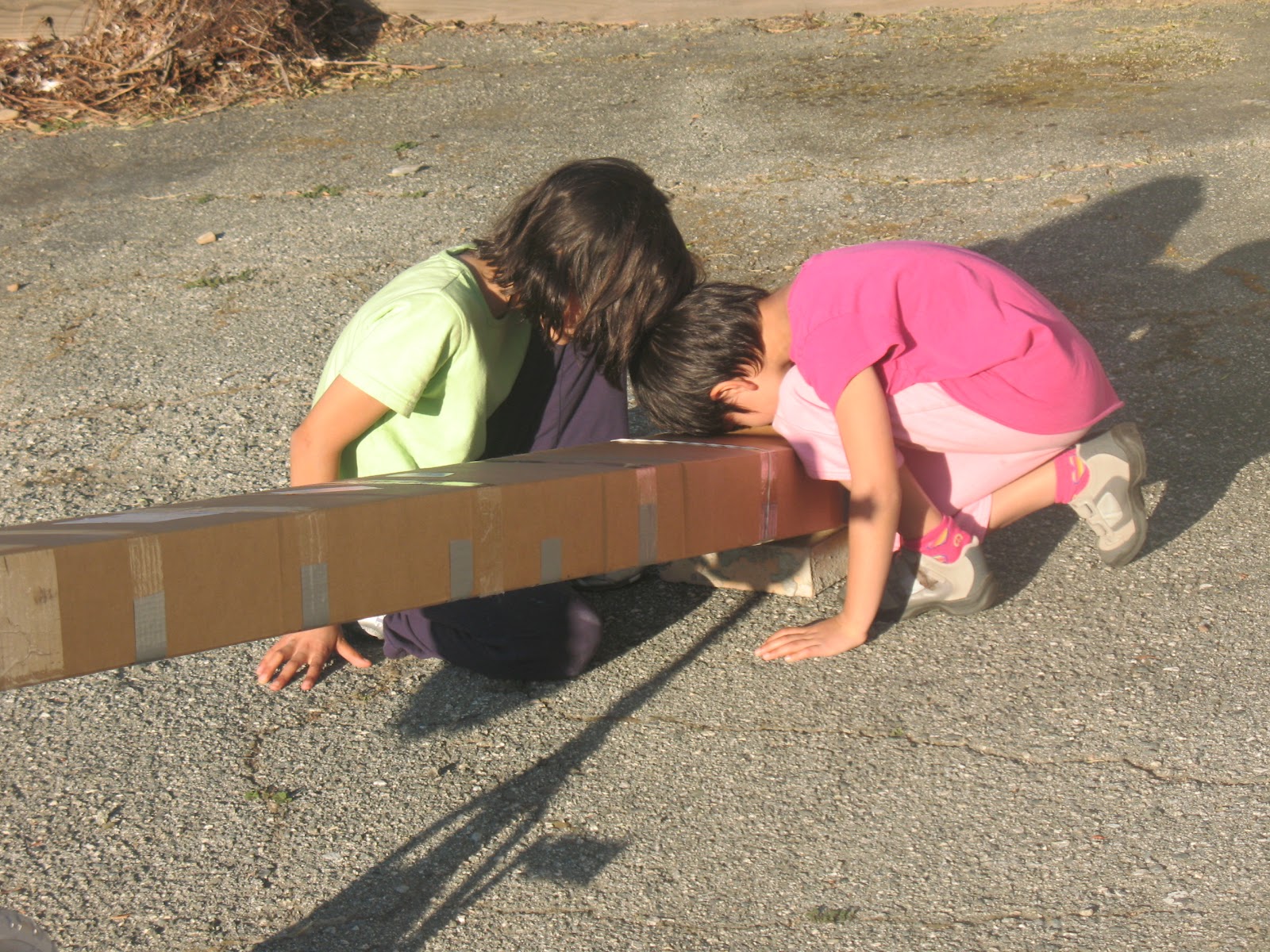
The atmosphere was festive, most people happily sharing their viewers and explaining the construction to others. My 7' long cardboard box, which could have housed a family of four squatters in Mumbai, drew a surprising lot of attention! Here are a few pictures, not very good ones, but perhaps some of the people who I met there will send me copies. Maya and Elsa don't appear in any of the photos because they took full advantage of their unstructured learning opportunity and with their new friends Rukmini and Ila ran around the crowd with their welders' glass and solar viewing glasses.
Woman with eclipses on her face through her straw hat.
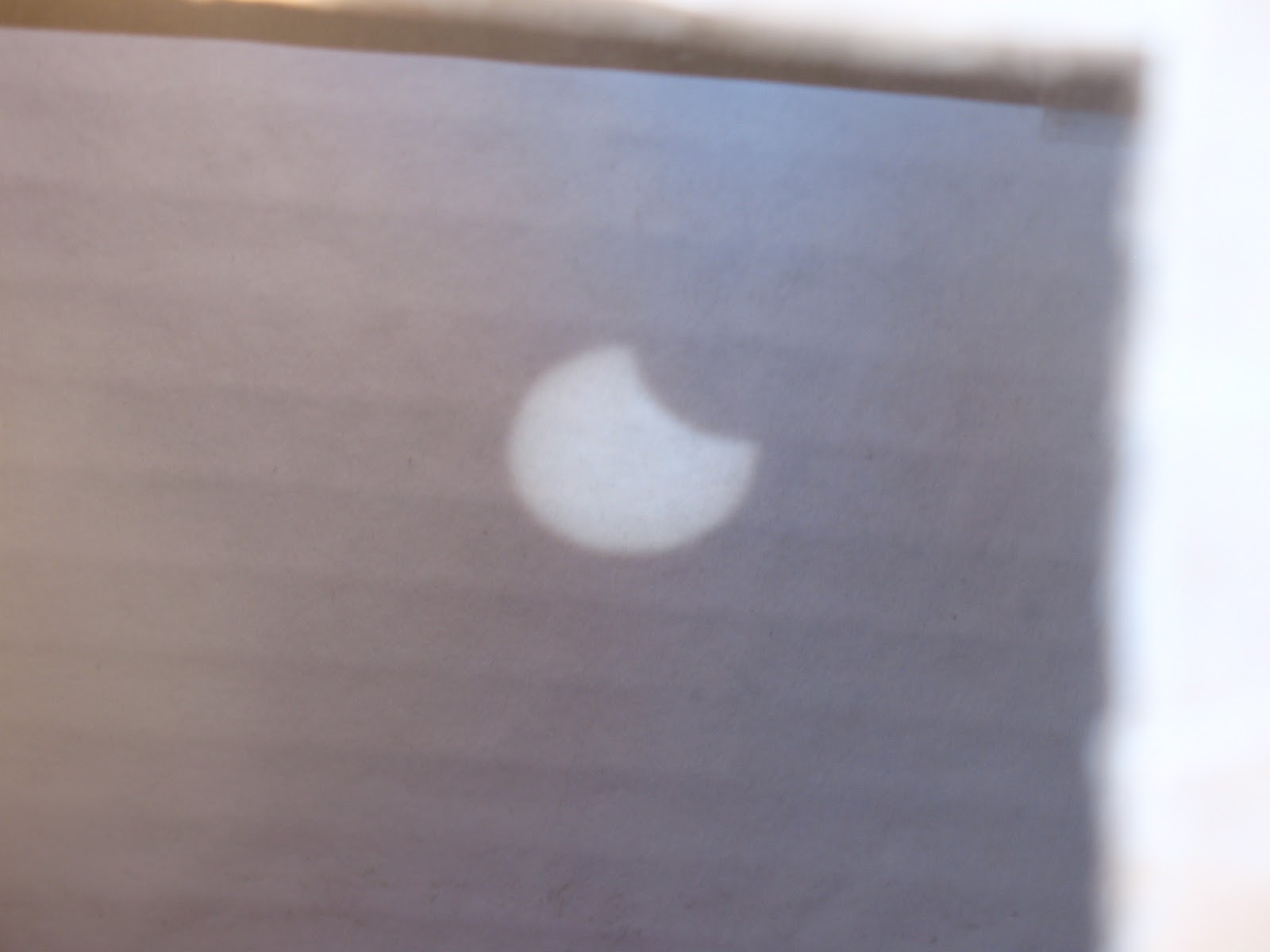
View in my pinhole camera, a few minutes after the start
A telescopic projector in which you could see the sunspots.
Der Sonnenteleskop
Photo through #10 welders' glass
Progressing.
My telescope projector. Is that a cloud in the sky?
There were expressions of disappointment all around, but look at how beautiful the cloud is!
It took a little bit of work and twiddling with the cheapy $20 telescope ( which is probably an excellent seismometer since it shakes with my heartbeat if I am within 5 feet of it!).
Since a telescope is designed to focus a virtual image on your retina with the help of a third lens (your cornea), in order to use it as an effective real image projection device (without setting the screen on fire!) the eyepiece has to be removed completely and held just outside the tube.
I've just realised that the 90 degree reflector for the eyepiece may give me that added distance!
Cut and install a screen around the objective side of the telescope to provide a dark back ground for the sun's image. Note that the spotter scope is rendered useless.
So you can insert a long tack or pushpin from the back of the screen to use as an aid in alignment.
Or just use the shadow of the body of the telescope. In the following photo the telescope is NOT aligned.
Ready for the ...
... lead astronomer.
You can see the sunspot groups: a streaky one angled towards 630, at 9 o'clock, half way out, and a second one at 8 o'clock about 2/3rds of the way out.
Since this image is taken at sunset, in this photo the sun's North pole is at about 9 o'clock, as is confirmed by the rotation of the sunspots that Maya and I have observed over the last two days.
In the first observation two days ago, the lower sunspot was just above the 9 o'clock radial, both were in the top left quadrant.
Photo of real image of sun in 7' pinhole camera, with large hole cut out of bottom of tube. Note the faintness of the image due to excess ambient light compared to small amount entering pinhole.
Photo after modification of the camera - a small, angled viewing aperture. Note the increase in contrast.
The modification.
I am going to add an additional screen on the side of the tube with the viewing aperture. The viewing aperture can be made smaller as well.
The complete pinhole camera ...
... being tested rigourously.
Taking turns.
Direct photo of sun with a 16X zoom digital camera ...
AND a #14 WELDERS' GLASS.
Do NOT point your camera directly at sun, you may burn out your CCD (as opposed to just the negative!).
Do NOT look directly at sun without a #14 welders' glass.
TRAIN your kids to use it: look down, glass to eyes, then raise head with glass and locate sun (not easy!). Look down again, then remove glass from face.
Looking at the sun with the #14 filter through a pair of binocs, two groups of sunspots are readily visible. Over one day, they've rotated in the RHScrew direction about the Solar North pole (approximately the same as earth's), meaning, at sunset, in the West, they've dropped down across the face of the sun.
Please leave other relevant useful links as comments.
Racing across the universe for the last 7.3 billion years, two gamma-ray photons arrived at NASA's orbiting Fermi Gamma-ray Space Telescope within nine-tenths of a second of one another. The dead-heat finish may stoke the fires of debate among physicists…
The article itself says that the difference in arrival times is "… likely due to the detailed processes of the gamma-ray burst…", i.e. in the source of the γ rays.
Addressing Kevin’s question in more detail:
The telescope was looking at the same part of the sky, presumably small enough to contain only one source of γ s. A Gamma ray burst was observed (bunch of γ s with energies between the two extremes mentioned in the article.). Gamma ray bursts last on the order of a couple of seconds (See above article.). On a macroscopic scale, the photons traverse the same spatial trajectory and intervening objects, but one is a few seconds behind the other. Nothing changes cosmologically on a scale of two seconds - except of course for gamma bursts and supernovae, which weren't observed. Macroscopic dispersive effects (change in refractive index due to frequency) in large intervening nebulae etc. cannot in principle be ruled out, but what do I know about astrophysics? Presumably they carefully chose a very empty part of the sky.
So, in order to reject the null hypothesis (that there are no differences in the speeds of the photons of different energies) any observed difference has to be >~ 2 secs. If there are hypothesized physical processes that do predict larger differences in arrival times, the observed 0.9 sec difference will put very tight constraints on the viability of those theories.
Now, watch the string theorists squeeze themselves through those very tight constraints! They have had 30 + years of practise!
There is classical, deterministic chaos, there are classical uncertainties due to stochastic processes, and we haven't even got to talking about QM! -in terms of causing frothiness in spacetime.
The point is that there are viable and very precise theories - "laws of the universe" - that separately either hypothesize or predict a "frothy" universe on a scale somewhere between 10-18m and the Planck scale (10-35m). The observations discussed put presumably very tight constraints on the free parameters in the theories that distinguish them from Einsteinian General Relativity.
If say the two photons had arrived more than 8 secs apart, the observations would tell us precisely how "frothy" spacetime actually is – how big are the hyopothesized microstructures, on what time scales do they change, how do they interact with different photons.
Even Einstein's very beautiful, very precise etc etc General Theory of Relativity CANNOT rule out frothiness of the universe on some heretofore unobserved, untested scale, though very good arguments can be made that the GTR will break down at some scale > Planck. If frothiness is observed at some larger scale, it will put a lower bound on the domain of applicability of the GTR (Since it hypothesizes a smooth (or at least twice differentiable) geometry for spacetime, GTR is valid above but not below the scale at which those “violations” are observed.).