Showing posts with label eclipse. Show all posts

Saturday, May 19, 2012

Sunspots on screen

See the initial post.

It took a little bit of work and twiddling with the cheapy $20 telescope ( which is probably an excellent seismometer since it shakes with my heartbeat if I am within 5 feet of it!).

Since a telescope is designed to focus a virtual image on your retina with the help of a third lens (your cornea), in order to use it as an effective real image projection device (without setting the screen on fire!) the eyepiece has to be removed completely and held just outside the tube.

 I've just realised that the 90 degree reflector for the eyepiece may give me that added distance!

Cut and install a screen around the objective side of the telescope to provide a dark back ground for the sun's image. Note that the spotter scope is rendered useless.

So you can insert a long tack or pushpin from the back of the screen to use as an aid in alignment.

Or just use the shadow of the body of the telescope. In the following photo the telescope is NOT aligned.

Ready for the ...
... lead astronomer.
You can see the sunspot groups: a streaky one angled towards 630, at 9 o'clock, half way out, and a second one at 8 o'clock about 2/3rds of the way out.

Since this image is taken at sunset, in this photo the sun's North pole is at about 9 o'clock, as is confirmed by the rotation of the sunspots that Maya and I have observed over the last two days.

In the first observation two days ago, the lower sunspot was just above the 9 o'clock radial, both were in the top left quadrant.

Not a bad hack!

Friday, May 18, 2012

Solar Eclipse Preparation

I am planning to drive with Maya and Elsa to Reno, NV to view the annular solar eclipse on May 20th.

Here are a few useful links:
Tips on preparation
simplified eclipse path
make a pinhole camera (see my bottom end modification to eliminate excess ambient light)
optical projection (place a sunglasses lens over the objective to keep things cool)
simulation of view from bay area at maximum
another chart

Photo of real image of sun in 7' pinhole camera, with large hole cut out of bottom of tube. Note the faintness of the image due to excess ambient light compared to small amount entering pinhole.

Photo after modification of the camera - a small, angled viewing aperture. Note the increase in contrast.

The modification.
I am going to add an additional screen on the side of the tube with the viewing aperture. The viewing aperture can be made smaller as well.

The complete pinhole camera ...

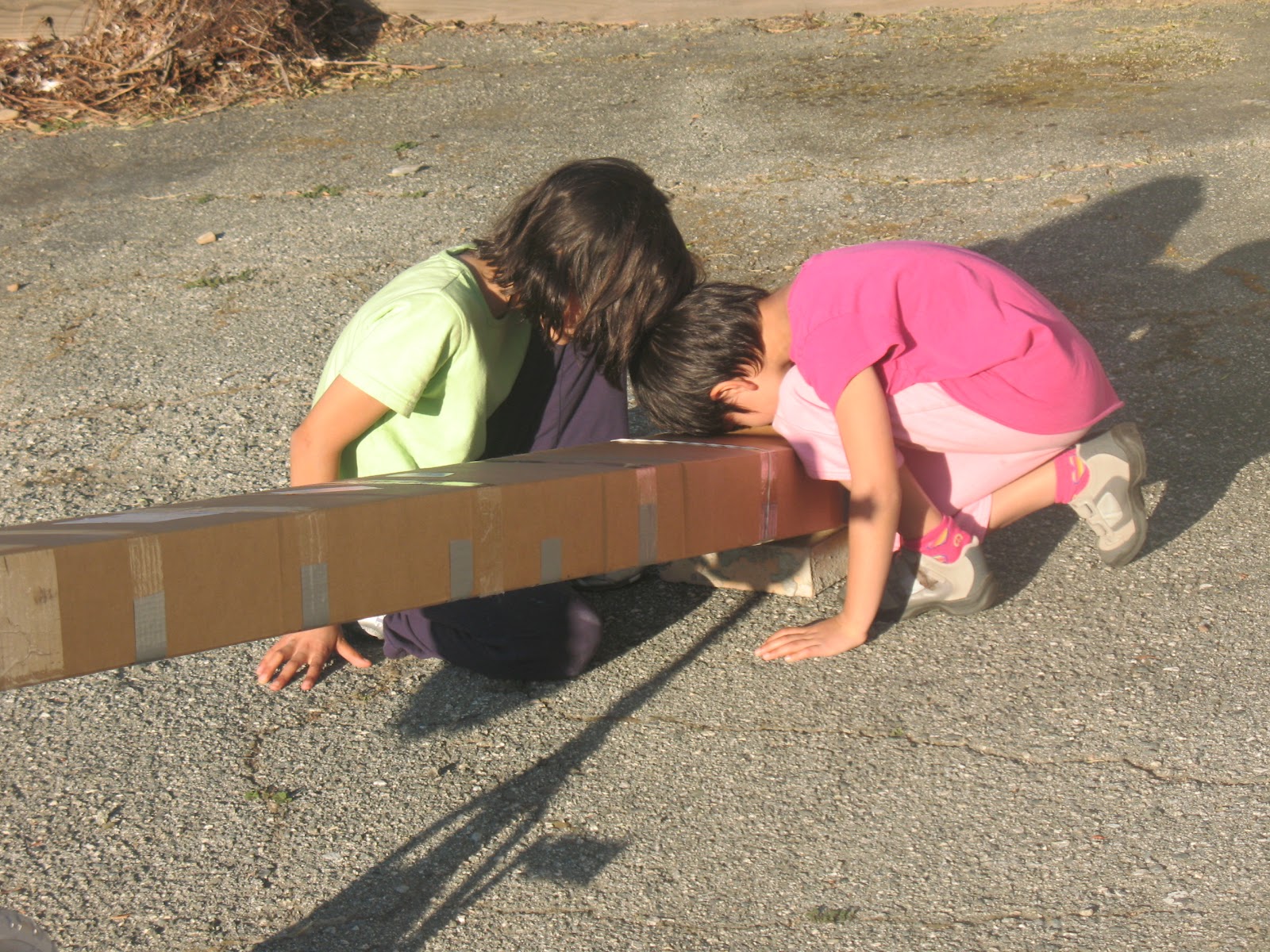
... being tested rigourously.

Taking turns.

Direct photo of sun with a 16X zoom digital camera ...
AND a #14 WELDERS' GLASS.

Do NOT point your camera directly at sun, you may burn out your CCD (as opposed to just the negative!).

Do NOT look directly at sun without a #14 welders' glass.

TRAIN your kids to use it: look down, glass to eyes, then raise head with glass and locate sun (not easy!). Look down again, then remove glass from face.

Looking at the sun with the #14 filter through a pair of binocs, two groups of sunspots are readily visible. Over one day, they've rotated in the RHScrew direction about the Solar North pole (approximately the same as earth's), meaning, at sunset, in the West, they've dropped down across the face of the sun.

Please leave other relevant useful links as comments.

See the follow-up with the sunspots.