Thank you Antra for the reminder!
Here are a few picks from the internet:
This video captures beautifully my thoughts on art and the endless arguments I have with artists about nature, science and art.
But Bloomsbury celebrates Feynman
what is science in 63 seconds
Feynman wiki
Gleick's fabulous biography
Feynman's video, and revisiting my own post, brought up some memories:
I'd once asked a fellow-scientist who was also an artist why she painted, and she responded with I believe a quote, that painting is an excuse to gaze upon nature. Not quite as terse as "because I can" nor "because it is there", but in the same space. I knew a painter in Madrid - Javier Fernandez Lizan, and on my first visit to his studio, at some point, after the above conversation, I asked Javier why he painted. Javier responded by taking me to a massive 8'X10' abstract still life with human figures, in oil, and showed me a 2 or 3 square inch area, and said "to capture this blue".
Why did I do science? Why do I analyse data now?
"Because it is there!"
"Because I can!"
"Because it is an excuse to gaze upon nature!"
"Beacuse I want to capture "this blue", which is in my head, and speaks to me, and I want to express it!"
"Because I am an instrument of "this blue"'s meme, and it expresses itself through me!"
So, I have never understood why it is that while most scientists find commonalities with artists ( my thoughts on art notwithstanding!), most artists keep trying to distance themselves from scientists!
Showing posts with label science. Show all posts
Showing posts with label science. Show all posts
Saturday, May 11, 2013


Friday, December 21, 2012
Why I am sad it is not a re-collapsing universe
Why I am soooooo sorry that we are apparently
(meaning according to the latest astronomical data and relativistic
cosmologies) no longer in a closed (re-collapsing) universe. According
to the latest, the expansion of the universe is decelerating, but at an
ever lower deceleration which will cumulatively not be enough to turn
the expansion around.
How terribly sad! Suppose that there were to have been enough mass density in the universe to cause the universe to stop expanding and then to contract. Then there are theorems in GR which state that within a finite time everything will recollapse to a final singularity.
Now, listen closely: We would then already be INSIDE the event horizon of the final singularity. Yes, you, me, the earth the sun the solar system the galaxy the local cluster the supercluster etc. You don't notice anything different do you? No "the earth shook" nor nothing, nada?
Being inside the event horizon of a sufficiently large, isolated Black Hole would feel exactly the same.
"But if I was inside the event horizon of a Black Hole wouldn't I be able to see the Black Hole I was falling towards!?"
Nope! A Black Hole, like any final singularity, is like next Monday. You can't see "next Monday" can you?
How terribly sad! Suppose that there were to have been enough mass density in the universe to cause the universe to stop expanding and then to contract. Then there are theorems in GR which state that within a finite time everything will recollapse to a final singularity.
Now, listen closely: We would then already be INSIDE the event horizon of the final singularity. Yes, you, me, the earth the sun the solar system the galaxy the local cluster the supercluster etc. You don't notice anything different do you? No "the earth shook" nor nothing, nada?
Being inside the event horizon of a sufficiently large, isolated Black Hole would feel exactly the same.
"But if I was inside the event horizon of a Black Hole wouldn't I be able to see the Black Hole I was falling towards!?"
Nope! A Black Hole, like any final singularity, is like next Monday. You can't see "next Monday" can you?
End of the World
In case you missed it, the world did end,
exactly according to prophecy. The end of the world started at the
barycentre of the pyramid of the magician in the Yucatan and radiated
out at the speed of light.
But the idiots who translated the prophecy forgot to translate the second page, which also prophesied that a new world would start with exactly the same initial data as was present on the outgoing lightcone of the end-of-the-world event. You didn't notice anything did you?
But what I really don't get is the self-hating "Westernized" Hindoos who fall all over each other to believe in the "new-age misinterpretation of Mayan calendar - the Maya Y2K" end of the world prophecy. Don't we have enough of our own revered and ancient crackpot astroboogers to believe in? Why do you have to outsource your insanity and take away domestic jobs from our own jyotishis and jadi-booti vendors?
But the idiots who translated the prophecy forgot to translate the second page, which also prophesied that a new world would start with exactly the same initial data as was present on the outgoing lightcone of the end-of-the-world event. You didn't notice anything did you?
But what I really don't get is the self-hating "Westernized" Hindoos who fall all over each other to believe in the "new-age misinterpretation of Mayan calendar - the Maya Y2K" end of the world prophecy. Don't we have enough of our own revered and ancient crackpot astroboogers to believe in? Why do you have to outsource your insanity and take away domestic jobs from our own jyotishis and jadi-booti vendors?
Friday, December 14, 2012


Wednesday, May 23, 2012
Postscript to "Nature in Art"
In response to various comments from both close friends and from
people who've known me for a couple of hours, which were along the lines
of
A not-so-young physicist, un Indio
Posted on his blog about VIBGYOR.
"The passion is clear,
The physics, 'No fear!',
But the tone, ahh that is a failure!"
After what RS, ARM, DST, SP, AP, SK, PSK, JB etc have put me through over the last few weeks in the "Home Truths Dept.", I think a Maoist re-education camp will be a piece of cake!
...
One of the above friends: "Do you acknowledge that you have been personally responsible for suppressing millions of hard-working peasants?"
RST: "Yes."
Same friend: "Wait, you've already self-confessed? I don't get to torture you?"
RST: "The other friends in the list above have said pretty much the same thing about me, so it must be true."
Some friend!: "So what are you going to do about it?"
RST: " 'Do about it?' ? What do you mean? That would require me to be different from what I am! ... Oh, I see your point!"
...
So here goes: I want that post to be seen as a learning opportunity about observing nature, not art criticism nor artist criticism. To be very very explicit: The artistic representations aren't incorrect representations of nature - they don't have to be, reality is not the only domain of art. They're just not realistic/scientific representations of nature. True, which doesn't prevent them from sometimes being spot-on in capturing some essence of nature.
In exchange, I would like acknowledgment that
1) scientists can appreciate beauty in nature, in spite of "having an equation for it", and that
2) scientists can appreciate art, in spite of being very analytical (Read any art reviews lately?).
In that post "wrong" should be interpreted not as a commentary on the moral nature of the artist, but rather as "observationally incorrect representation of nature, but of course the artist has artistic license to do what she or he wants, just use this as an excuse to step outside and look, really look, at a rainbow!"
A painter friend of mine in Madrid (Javier F L) put it best when I asked him why he painted, "I paint because it gives me an excuse to gaze for long periods of time." I couldn't disagree less about why I do science, or data analytics for that matter. (This isn't helping me get a job, is it?)
A not-so-young physicist, un Indio
Posted on his blog about VIBGYOR.
"The passion is clear,
The physics, 'No fear!',
But the tone, ahh that is a failure!"
After what RS, ARM, DST, SP, AP, SK, PSK, JB etc have put me through over the last few weeks in the "Home Truths Dept.", I think a Maoist re-education camp will be a piece of cake!
...
One of the above friends: "Do you acknowledge that you have been personally responsible for suppressing millions of hard-working peasants?"
RST: "Yes."
Same friend: "Wait, you've already self-confessed? I don't get to torture you?"
RST: "The other friends in the list above have said pretty much the same thing about me, so it must be true."
Some friend!: "So what are you going to do about it?"
RST: " 'Do about it?' ? What do you mean? That would require me to be different from what I am! ... Oh, I see your point!"
...
So here goes: I want that post to be seen as a learning opportunity about observing nature, not art criticism nor artist criticism. To be very very explicit: The artistic representations aren't incorrect representations of nature - they don't have to be, reality is not the only domain of art. They're just not realistic/scientific representations of nature. True, which doesn't prevent them from sometimes being spot-on in capturing some essence of nature.
In exchange, I would like acknowledgment that
1) scientists can appreciate beauty in nature, in spite of "having an equation for it", and that
2) scientists can appreciate art, in spite of being very analytical (Read any art reviews lately?).
In that post "wrong" should be interpreted not as a commentary on the moral nature of the artist, but rather as "observationally incorrect representation of nature, but of course the artist has artistic license to do what she or he wants, just use this as an excuse to step outside and look, really look, at a rainbow!"
A painter friend of mine in Madrid (Javier F L) put it best when I asked him why he painted, "I paint because it gives me an excuse to gaze for long periods of time." I couldn't disagree less about why I do science, or data analytics for that matter. (This isn't helping me get a job, is it?)
Monday, May 21, 2012
Annular Solar Eclipse
Maya, Elsa and I drove to Pleasanton, from where we carpooled with Sudhir and his family to Reno. When we got to the Univ. of Nevada, the grassy are was replete with a wide variety of viewing instruments, ranging from a pinhole camera kit, through home made wooden binocular stands to 8" telescopes with motors and computerized drives. A very large number of people had shown unprepared and queued up for the solar viewing glasses that someone was selling for $10 apiece. Just for comparison, the #14 welders' glass cost me $3 apiece.
Inspired by TIEcon2012, I saw a business opportunity and made a hole bunch of money selling pinholes for $5 each (cards not included).
The atmosphere was festive, most people happily sharing their viewers and explaining the construction to others. My 7' long cardboard box, which could have housed a family of four squatters in Mumbai, drew a surprising lot of attention! Here are a few pictures, not very good ones, but perhaps some of the people who I met there will send me copies. Maya and Elsa don't appear in any of the photos because they took full advantage of their unstructured learning opportunity and with their new friends Rukmini and Ila ran around the crowd with their welders' glass and solar viewing glasses.
Inspired by TIEcon2012, I saw a business opportunity and made a hole bunch of money selling pinholes for $5 each (cards not included).
The atmosphere was festive, most people happily sharing their viewers and explaining the construction to others. My 7' long cardboard box, which could have housed a family of four squatters in Mumbai, drew a surprising lot of attention! Here are a few pictures, not very good ones, but perhaps some of the people who I met there will send me copies. Maya and Elsa don't appear in any of the photos because they took full advantage of their unstructured learning opportunity and with their new friends Rukmini and Ila ran around the crowd with their welders' glass and solar viewing glasses.
 |
| Woman with eclipses on her face through her straw hat. |
 |
| View in my pinhole camera, a few minutes after the start |
 |
| A telescopic projector in which you could see the sunspots. |
 |
| Der Sonnenteleskop |
 |
| Photo through #10 welders' glass |
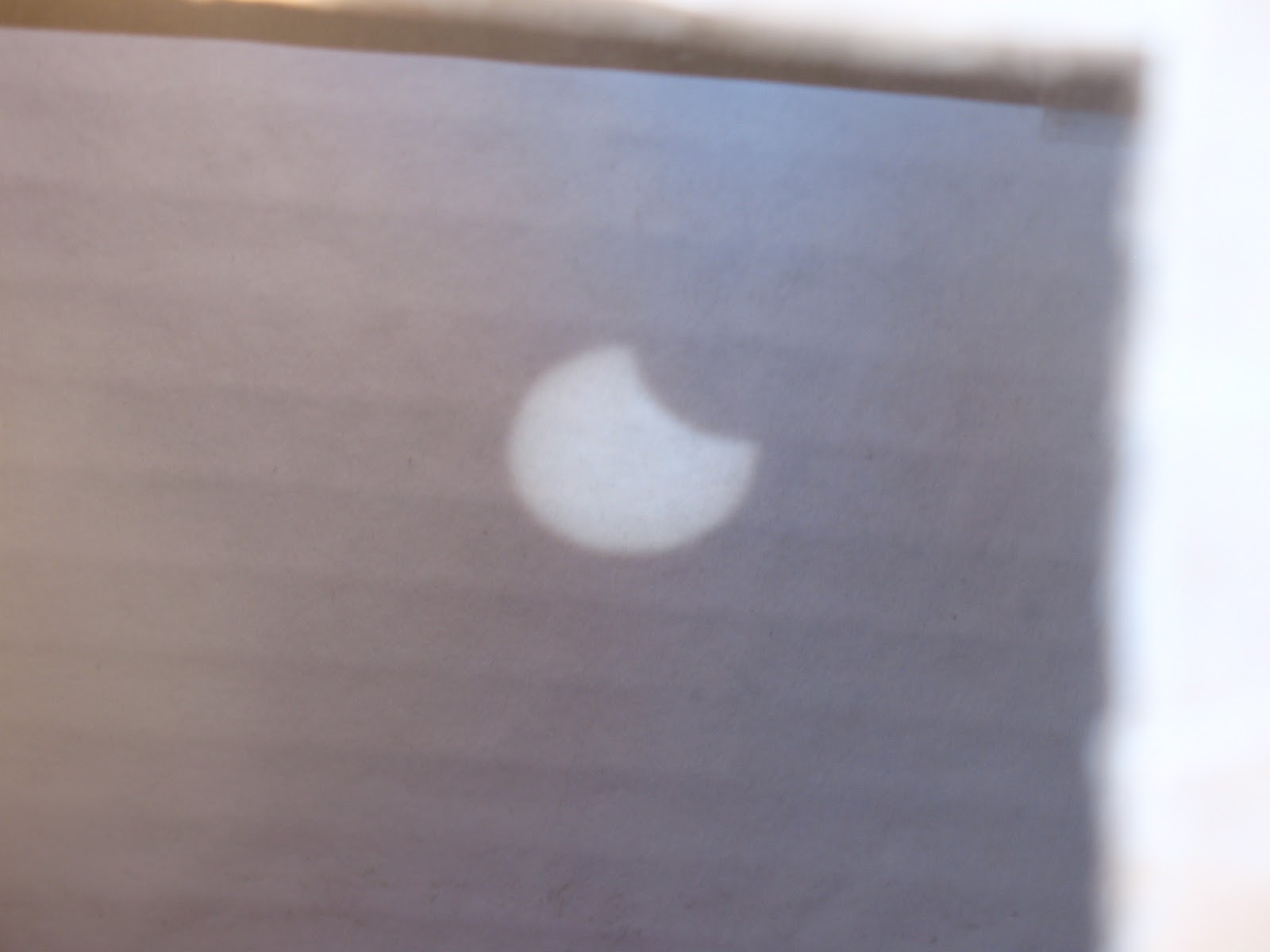 |
| Progressing. |
 |
| My telescope projector. Is that a cloud in the sky? |
 |
| There were expressions of disappointment all around, but look at how beautiful the cloud is! |
 |
| 15 minutes before maximum. |
 |
| The cloud moved aside just in time. |
 |
| Add caption |
Saturday, May 19, 2012
Sunspots on screen
See the initial post.
It took a little bit of work and twiddling with the cheapy $20 telescope ( which is probably an excellent seismometer since it shakes with my heartbeat if I am within 5 feet of it!).
Since a telescope is designed to focus a virtual image on your retina with the help of a third lens (your cornea), in order to use it as an effective real image projection device (without setting the screen on fire!) the eyepiece has to be removed completely and held just outside the tube.
 I've just realised that the 90 degree reflector for the eyepiece may give me that added distance!
Cut and install a screen around the objective side of the telescope to provide a dark back ground for the sun's image. Note that the spotter scope is rendered useless.

So you can insert a long tack or pushpin from the back of the screen to use as an aid in alignment.

Or just use the shadow of the body of the telescope. In the following photo the telescope is NOT aligned.

Ready for the ...
 You can see the sunspot groups: a streaky one angled towards 630, at 9 o'clock, half way out, and a second one at 8 o'clock about 2/3rds of the way out.
Since this image is taken at sunset, in this photo the sun's North pole is at about 9 o'clock, as is confirmed by the rotation of the sunspots that Maya and I have observed over the last two days.
In the first observation two days ago, the lower sunspot was just above the 9 o'clock radial, both were in the top left quadrant.
Not a bad hack!
It took a little bit of work and twiddling with the cheapy $20 telescope ( which is probably an excellent seismometer since it shakes with my heartbeat if I am within 5 feet of it!).
Since a telescope is designed to focus a virtual image on your retina with the help of a third lens (your cornea), in order to use it as an effective real image projection device (without setting the screen on fire!) the eyepiece has to be removed completely and held just outside the tube.

Cut and install a screen around the objective side of the telescope to provide a dark back ground for the sun's image. Note that the spotter scope is rendered useless.

So you can insert a long tack or pushpin from the back of the screen to use as an aid in alignment.

Or just use the shadow of the body of the telescope. In the following photo the telescope is NOT aligned.

 |
| ... lead astronomer. |

Since this image is taken at sunset, in this photo the sun's North pole is at about 9 o'clock, as is confirmed by the rotation of the sunspots that Maya and I have observed over the last two days.
In the first observation two days ago, the lower sunspot was just above the 9 o'clock radial, both were in the top left quadrant.
Not a bad hack!
Friday, May 18, 2012
Solar Eclipse Preparation
I am planning to drive with Maya and Elsa to Reno, NV to view the annular solar eclipse on May 20th.
Here are a few useful links:
Tips on preparation
simplified eclipse path
make a pinhole camera (see my bottom end modification to eliminate excess ambient light)
optical projection (place a sunglasses lens over the objective to keep things cool)
simulation of view from bay area at maximum
another chart
I am going to add an additional screen on the side of the tube with the viewing aperture. The viewing aperture can be made smaller as well.
AND a #14 WELDERS' GLASS.
Do NOT point your camera directly at sun, you may burn out your CCD (as opposed to just the negative!).
Do NOT look directly at sun without a #14 welders' glass.
TRAIN your kids to use it: look down, glass to eyes, then raise head with glass and locate sun (not easy!). Look down again, then remove glass from face.
Looking at the sun with the #14 filter through a pair of binocs, two groups of sunspots are readily visible. Over one day, they've rotated in the RHScrew direction about the Solar North pole (approximately the same as earth's), meaning, at sunset, in the West, they've dropped down across the face of the sun.
Please leave other relevant useful links as comments.
See the follow-up with the sunspots.
Here are a few useful links:
Tips on preparation
simplified eclipse path
make a pinhole camera (see my bottom end modification to eliminate excess ambient light)
optical projection (place a sunglasses lens over the objective to keep things cool)
simulation of view from bay area at maximum
another chart
 |
| Photo of real image of sun in 7' pinhole camera, with large hole cut out of bottom of tube. Note the faintness of the image due to excess ambient light compared to small amount entering pinhole. |
 |
| Photo after modification of the camera - a small, angled viewing aperture. Note the increase in contrast. |
 |
| The modification. |
 |
| The complete pinhole camera ... |
 |
| ... being tested rigourously. |
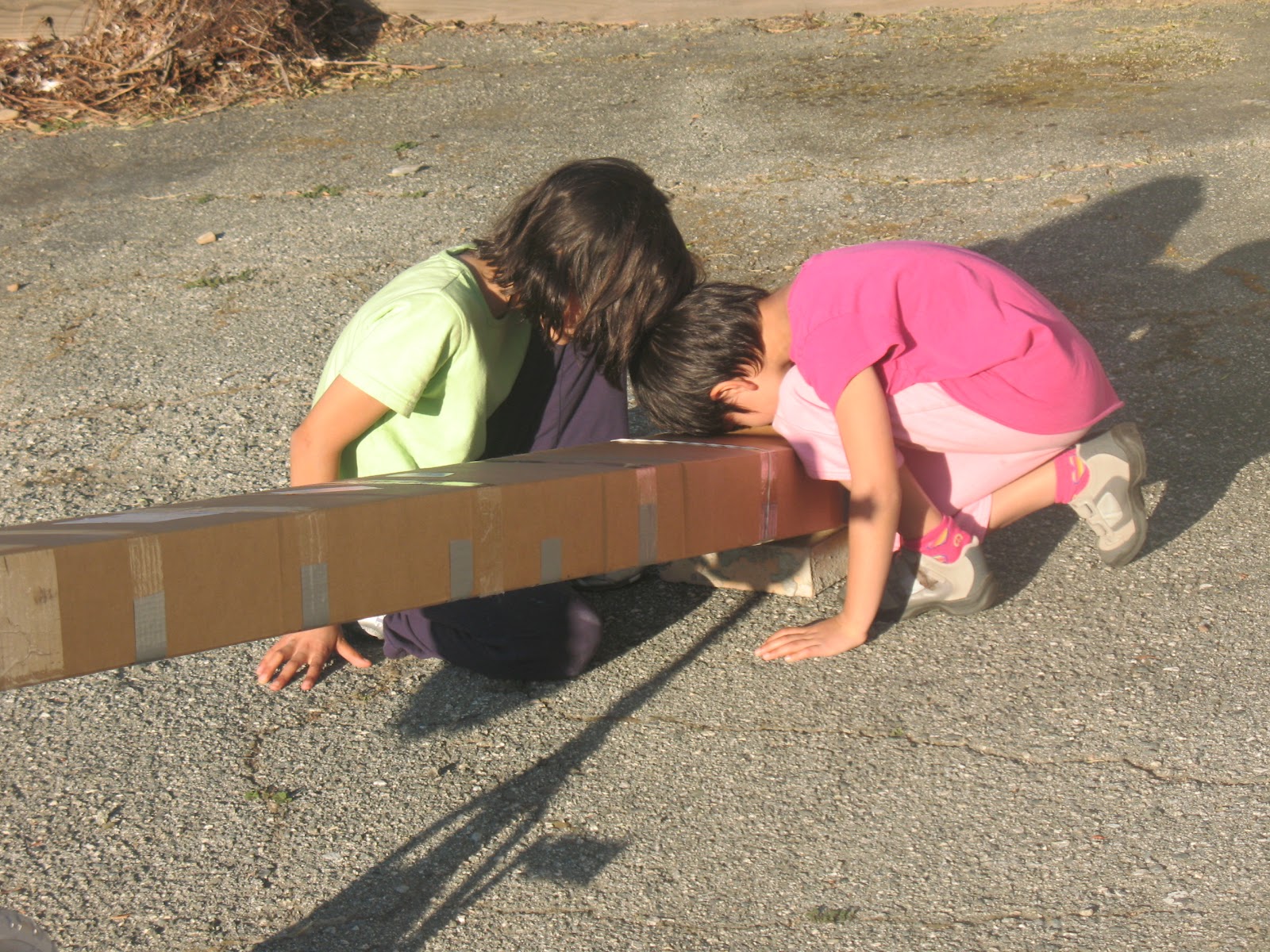 |
| Taking turns. |
 |
| Direct photo of sun with a 16X zoom digital camera ... |
Do NOT point your camera directly at sun, you may burn out your CCD (as opposed to just the negative!).
Do NOT look directly at sun without a #14 welders' glass.
TRAIN your kids to use it: look down, glass to eyes, then raise head with glass and locate sun (not easy!). Look down again, then remove glass from face.
Looking at the sun with the #14 filter through a pair of binocs, two groups of sunspots are readily visible. Over one day, they've rotated in the RHScrew direction about the Solar North pole (approximately the same as earth's), meaning, at sunset, in the West, they've dropped down across the face of the sun.
Please leave other relevant useful links as comments.
See the follow-up with the sunspots.
Thursday, May 10, 2012
Home Made Cannon
All videos taken with a Flip video camera, and the slides are simply still captures from the video. I couldn't have captured the photos without a video camera, and the Flip has astoundingly good resolution!
Slides of failed attempts
The table should be NON-flammable!
Video 0
Video 1
Video 2
Video 3
Slides of fascinating stills of successful shots
Slides of failed attempts
The table should be NON-flammable!
Video 0
Video 1
Video 2
Video 3
Slides of fascinating stills of successful shots
Monday, April 9, 2012
Nature in Turgenev
Nature in Turgenev (Bezhin Meadow):
1. "It was a beautiful July day ... the sunset was fading ... I must have gone a good mile out of my way! ... Meanwhile, night was falling ... the night. Little stars ... twinkled in it. ... I walked like that for half an hour. ... my legs were giving way under me from exhaustion. ... We talked a little. ... the two dogs ... could not reconcile themselves to my presence for a long time, ... "taters" were cooking. ... More than three hours had passed since I had joined the company of the boys ... the moon rose ... it was so small and narrow. ... before the dawn ... the short nights of summer."
At first this set of narrative time markers puzzled me. Four hours after nightfall, the small and narrow moon rises just before the dawn. A waning crescent moon precedes the sun by only a couple of hours. So the night is at most 6 hours long! But it is July, and Chern District, Tula province is located only about 250 km south of Moscow, at 54 N latitude, where a five hour July night is real.
2. "... the damp freshness of late evening had given way to the dry warmth of midnight,". WTF? Surely it should be "... the dry warmth of late evening had given way to the damp freshness of midnight,". I retract this criticism. A friend pointed out that in SF the night temperatures are higher than during the evening and twilight, when there is a strong offshore wind bringing in cold from the Humboldt current.
3. "There was no moon in the sky: at that time of year it rose late." Hunh? The moon rises late for a week once every lunar cycle, it has nothing to do with the time of year. "There was no moon in the sky: at that time of month it rose late." would be tautological.
4. Finally, the phrase for which I will forgive Turgenev ALL his anti-observational sins (recall he is writing this in the early 1850s!): "The numberless golden stars ... looking at them, you seemed to be dimly aware yourself of the headlong and unceasing course of the earth." A writer who has read and understood Copernicus and Galileo! Most of us, anthropocentrists, are still only aware, if of anything, of the stars whirling around the earth.
Review of characters in Turgenev
Buy the book at Leigh's Favorite Books in Sunnyvale, CA
1. "It was a beautiful July day ... the sunset was fading ... I must have gone a good mile out of my way! ... Meanwhile, night was falling ... the night. Little stars ... twinkled in it. ... I walked like that for half an hour. ... my legs were giving way under me from exhaustion. ... We talked a little. ... the two dogs ... could not reconcile themselves to my presence for a long time, ... "taters" were cooking. ... More than three hours had passed since I had joined the company of the boys ... the moon rose ... it was so small and narrow. ... before the dawn ... the short nights of summer."
At first this set of narrative time markers puzzled me. Four hours after nightfall, the small and narrow moon rises just before the dawn. A waning crescent moon precedes the sun by only a couple of hours. So the night is at most 6 hours long! But it is July, and Chern District, Tula province is located only about 250 km south of Moscow, at 54 N latitude, where a five hour July night is real.
2. "... the damp freshness of late evening had given way to the dry warmth of midnight,". WTF? Surely it should be "... the dry warmth of late evening had given way to the damp freshness of midnight,". I retract this criticism. A friend pointed out that in SF the night temperatures are higher than during the evening and twilight, when there is a strong offshore wind bringing in cold from the Humboldt current.
3. "There was no moon in the sky: at that time of year it rose late." Hunh? The moon rises late for a week once every lunar cycle, it has nothing to do with the time of year. "There was no moon in the sky: at that time of month it rose late." would be tautological.
4. Finally, the phrase for which I will forgive Turgenev ALL his anti-observational sins (recall he is writing this in the early 1850s!): "The numberless golden stars ... looking at them, you seemed to be dimly aware yourself of the headlong and unceasing course of the earth." A writer who has read and understood Copernicus and Galileo! Most of us, anthropocentrists, are still only aware, if of anything, of the stars whirling around the earth.
Review of characters in Turgenev
Buy the book at Leigh's Favorite Books in Sunnyvale, CA
Wednesday, March 14, 2012
MatricesForKids
 |
| Fig 1. |
0) How many properties does each piece have? There is a "correct" relevant answer, but answer this your own way.
1) How many pieces should there be in total to make the set "complete"?
2) How many colors are there?
3) How many shapes are there?
4) Now answer question 1.
5) How many pieces are missing?
6) Is there any set of the same shape with all the colors?
7) Is there any set of the same color with all the shapes?
8) What are the missing pieces?
 |
| Fig. 2 |
 |
| Fig. 3 |
 |
| Fig. 4 |
OccupyEggs2
OccupyEggs1
Why she liked Hemingway, DWM, misogynist because of all the women he'd loved who hadn't loved him back the way the rivers and seas and mountains did, she couldn't even begin to explain why she liked Hemingway. She'd never read him in school, none of the girls from school had, only certain and very few geeky and wannabe macho guys she knew had read him in school. In the Women's Studies course in college, he was their first assignment, and it was painfully easy to do a feminist deconstruction, and it was all over in a few seconds. Yet there were certain passages that had become ingrained in her brain, and fried eggs were forever associated with Hemingway the way rainbows were forever associated with Rutherford.
She'd learned Rutherford's analysis and explanation of rainbows in her third year in college, in a new physics class she'd taken as an elective, after her women's studies phase and after she'd gone back to her geek roots. Her artsy friends spoke as if science and understanding ruined one's love of nature, but Rutherford had not ruined her appreciation of the beauty of rainbows. Like Hemingway had increased her appreciation of fried egg sandwiches, after Rutherford she now gazed at rainbows for longer, observed them in all their nuances, in their environment, looking for all the features they could have but only sometimes displayed, and always just-so, the order of the colors, the geometry, the astronomical atmospheric effects. What Rutherford had ruined for her was her appreciation of “rainbow art” - the meaningless paeans to the “beauty of the rainbow”, telling without showing, without knowing, and the landscapes with fanciful rainbows, most of which got wrong the most elementary observational facts about rainbows and which, to her, indicated a disdain towards nature on the part of the artists. But Hemingway had not analogously ruined fried eggs for her, nor even art, perhaps because artists didn't take on fried eggs on a plate in the way they took on fruit in a bowl or fish skeletons on a plate or a rainbow in the sky.
OccupyEggs3
Why she liked Hemingway, DWM, misogynist because of all the women he'd loved who hadn't loved him back the way the rivers and seas and mountains did, she couldn't even begin to explain why she liked Hemingway. She'd never read him in school, none of the girls from school had, only certain and very few geeky and wannabe macho guys she knew had read him in school. In the Women's Studies course in college, he was their first assignment, and it was painfully easy to do a feminist deconstruction, and it was all over in a few seconds. Yet there were certain passages that had become ingrained in her brain, and fried eggs were forever associated with Hemingway the way rainbows were forever associated with Rutherford.
She'd learned Rutherford's analysis and explanation of rainbows in her third year in college, in a new physics class she'd taken as an elective, after her women's studies phase and after she'd gone back to her geek roots. Her artsy friends spoke as if science and understanding ruined one's love of nature, but Rutherford had not ruined her appreciation of the beauty of rainbows. Like Hemingway had increased her appreciation of fried egg sandwiches, after Rutherford she now gazed at rainbows for longer, observed them in all their nuances, in their environment, looking for all the features they could have but only sometimes displayed, and always just-so, the order of the colors, the geometry, the astronomical atmospheric effects. What Rutherford had ruined for her was her appreciation of “rainbow art” - the meaningless paeans to the “beauty of the rainbow”, telling without showing, without knowing, and the landscapes with fanciful rainbows, most of which got wrong the most elementary observational facts about rainbows and which, to her, indicated a disdain towards nature on the part of the artists. But Hemingway had not analogously ruined fried eggs for her, nor even art, perhaps because artists didn't take on fried eggs on a plate in the way they took on fruit in a bowl or fish skeletons on a plate or a rainbow in the sky.
OccupyEggs3
Friday, March 9, 2012
LiveArtCinequest2012
On our way out from the Shorts3 collection, we saw 3 artists in the act. Both Maya and Elsa wanted to stay and watch, so we went in to see them.
Joe had
F = m a
Newton's law of gravitation
Maxwell's silver equations
Black Hole entropy
Informational entropy
I suggested the following:
G_ab = 8 Pi G T_ab (The Einstein equation)
[x,p] = i hbar I (The fundamental fact about Quantum Mechanics.)
The commutator between a simple loop and a trefoil knot with a "hand", representing Loop Quantum Gravity
and Maxwell's equations
d F = 0 (the EM 4-tensor is divergence free)
d *F = *j (the curl of its dual is the dual of the 4-current co-vector).
9 March update: Joe put in all those suggestions!
Joe also added my name next to Newton's Equation for Gravitation, I'll post that as soon as Rajesh Aji sends me a copy.
 |
| Corey about to board the metro to school. |
 |
| Sara's painting dedicated to International Working Women's Day - March 8, 2012. |
 |
| "You accusing me of copying? I never even been to no fifteen or sixteen chapel!" |
 |
| Joe talking about his work, right before I started to talk about his work! |
 |
| Beneath those funky triangle symbols, there are 4 horizontal lines and Maxwell's silver hammer! |
 |
| No! No! No! Gravity isn't a force! |
 | |||
| Joe and myself, after we shared equations. |
F = m a
Newton's law of gravitation
Maxwell's silver equations
Black Hole entropy
Informational entropy
I suggested the following:
G_ab = 8 Pi G T_ab (The Einstein equation)
[x,p] = i hbar I (The fundamental fact about Quantum Mechanics.)
The commutator between a simple loop and a trefoil knot with a "hand", representing Loop Quantum Gravity
and Maxwell's equations
d F = 0 (the EM 4-tensor is divergence free)
d *F = *j (the curl of its dual is the dual of the 4-current co-vector).
9 March update: Joe put in all those suggestions!
 |
| Ashtekar variables, and you can just about discern a loop commutator. |
 | ||
| The Einstein Equation (Gravitation, or the E=mc^2 of General Relativity) |
Sunday, March 4, 2012
MoonVenusConjunction
 |
| Susan Arastradero's photo of a Moon-Venus conjunction. |
Q0. If there is no reflection of the photograph, and assuming the photo is taken in the northern heimsphere, can you tell whether it is at sunrise or sunset?
Answer: First determine the ecliptic, this is the plane containing the observer and the "arrow" defined by the Moon's "bow". IN the northern hemisphere, the zenith of the ecliptic is in the south, so S is to your right, North to your left and hence you are facing East and it is sunrise. Susan had mentioned to me that she had not traveled outside CA to anywhere but Arizona and Cuba, which are all in the northern hemisphere. Then she mentions in her e-mail that she had just enough time to take the picture before the sky became too light.
Here is another puzzle, based on an excerpt from her e-mail: "At first I thought the shape of Venus was blurred 'till a friend pointed out that it was earth's shadow."
Q1. What do you discern of Venus' shape?
Answer: A crescent.
Q2. Why is it impossible that the crescent is defined by earth's shadow?
Answer: I'll leave that to you.
Q3. What is the cause of the crescent shape of Venus?
Answer: That is the part of Venus that is lit by the Sun! The gedankenarrow in the bow formed by Venus' crescent points towards the Sun, as does the crescent Moon.
Q4. Is Venus on the near or the far side of the Sun?
Answer: The near side. If it were at the points on its orbit tangent to us, i.e. the Sun and Venus were to be equidistant to us, we would see Venus exactly half lit. If it were at points further, and hence on the other side, we would see more of its face lit (in extremis in opposition to us or in far conjunction with the Sun we would see the Full Venus) and hence a gibbous Venus. Since we see a crescent Venus, we know it is on the near side, since we see less than half of its face lit by the Sun (again, in extremis, when Venus is in near conjunction with the Sun we see a "dark" or New Venus).
Wednesday, February 29, 2012
Observations of Nature in Art
May 23rd 2012, Please read this DISCLAIMER before proceeding. Today's edits are in red.
RAINBOWS:
A. What is wrong with this picture?

So the only real image of the rainbow is the one that is projected onto your retina and which is then processed by your brain. Now since that is just as true for your friend as it is for you, what that means is that each and every person has their own personal rainbow, and she or he is at the center of it! That is a pretty good analogy for consciousness of the universe.
You'll never see a rainbow as an ellipse, less so as co-axial elliptical bands. If we insist on imagining what it would look like to another observer far to the left of us, it would still not look like the above where the red arc remains on the left edge and the blue arc remains on the right edge. The colors form concentric annular discs, so the red arc should be imagined to stay on the outside edge of the elliptical form, and the blue arc on the inside edge.
B. What is wrong with this picture?
 The three rainbows have three different centers, implying three sources of light! On a planet with three or more spectrally identical suns, this landscape is possible. However, since rainbows are virtual images, they would not obscure one another.
Ignoring the rainbow on the right, non-concentric double rainbows are in principle possible. The lower one (whose center is the shadow of your head and is below the horizon) is the normal one formed by light from the sun refracting and reflecting off the raindrops. The upper rainbow, with its center above the horizon, is formed by sunlight which is first reflected by the body of water in the foreground, and then impinges at an upward angle on the raindrops! The center of the reflection rainbow is where the shadow of your head would appear to be after reflection from (a continuation of) the expanse of water. Because of the landforms, the upper rainbow should be incomplete except where there is water directly below the lower rainbow. What a thought-provoking painting!
Now, just as we can see multiple shadows due to multiple lights, for example at night in an illuminated parking lot, with some luck and lots of practice with a hose spraying water, one might be able to see three rainbows as well.
C. What is wrong with this picture?

The sun is under the rainbow? Whatever the artist is smoking, I want some! This was seen by some of my readers as being derisive towards the artist. By no means! I really really do want some! A rather prosaic way of achieving the same effect would be to have a filtered mirror in front and just to the side of you while looking at the rainbow. By the way, even if the sun was above the rainbow it would still be wrong. Here is an excerpt from the page of an observant artist : "On a showery day, one may be blessed with the appearance of a rainbow. It is visible in an area of the sky opposite the light source."
D. What is wrong with this picture?
 The order of the colors is inverted, as the artist could have ascertained by umm ... looking. But hey! Why look at nature when you can do an art project? Or go online to check whether it is raining? What I think bothers me here is that young children, even when they see a rainbow, are perhaps missing the time with an adult who could help them look at the rainbow. By which I mean observe and mindfulness, which is a first step towards both science and art.
The angles for the first maximum, or the primary rainbow, are proportional to the wavelength. A rainbow, or anything else with a spectrum, requires dispersion, i.e. wavelength dependence of the relative refractive index of the material of the drops (water) in the atmosphere (air). In water, shorter wavelengths (blue) are dispersed more than longer wavelengths (red). Hence one might expect that red be on the inside and blue be on the outside, as in the above painting. However, the light is also reflected from the back wall of the droplet and purely due to the geometry of this reflection, the colors cross each other and are inverted. See the wikipedia rainbow article.
E. What is wrong with this picture?
 This is more subtle! Again, all the artist need have done is look! From inside to outside, the colors in the secondary rainbow go from red to blue! The secondary rainbow is formed when the light is reflected inside the rainbow twice! This causes the order of the colors to be inverted yet again and back to the original "blue is dispersed more". I'll confess that I haven't figured out the geometry of this, and neither has wikipedia.
 i) The two rainbows are concentric, and the shadows cast by objects are consistent with the position of the sun. That is, the line joining the observer to the center of the rainbow is parallel to the lines joining objects to their shadows.
ii) However, I would have expected to see the shadow of the artist's head at the geometric center of the rainbow, near the bottom, but by my reckoning within the frame of the painting. This is a minor quibble.
G. In contrast, what is right with this picture?
 The order of the colors of the secondary rainbow. An artist actually looked at nature! (Okay, the last sentence is unneccesary.)
G. What are two things wrong with this picture?
 First, the only way the rainbow can be seen in front of the background trees is if there is rain or mist between the artist and the trees, which, from the clarity of appearance of the sheep and houses near the "pot-of-gold" point, does not appear to be the case. Second, from the artist's viewpoint one can see close to 180 degrees worth of the rainbow, implying that the sun is at the horizon. This is inconsistent with the rather short length of the children's shadows, which indicate the sun to be about halfway to the zenith, or about 45 degrees above the horizon, in which case the rainbow shouldn't be visible at all! (The sun has to be less than 42 degrees above the horizon, since that is the outer conical angle of the rainbow.)
SNOWFLAKES: The next time I see non-C6 symmetry snowflakes I'll scream.
Scream 1
Scream 2
Scream 3

The USPS, which tends not to be particularly science friendly, did use actual photos of snowflakes for their stamps.

To which one can only say,
"Naught immortal hand nor eye
could frame thy C6 symmetry"
Next up: descriptions of nature in Turgenev.
RAINBOWS:
A. What is wrong with this picture?

(Thanks to Shailesh S for motivating the following.)
Have you ever seen an elliptical rainbow? No? Let's ask ourselves why not? Imagine looking at a circle, a child's hula, or a hoop-earring in a 3/4 profile photo of a beautiful woman looking out over a seascape (just saying!). The hula-hoop appears as a circle only from one particular angle, out of 2 Pi steradians. To anyone else looking at it, it appears as an ellipse. This becomes clear when they are as far to one side of you as you are from the hula-hoop. Now imagine that there is a big evening rainfront about 20 miles to your East, and you see a rainbow (in the East, why?), and your friend who lives 20 miles to your North texts you, "i c byu t ful rnbo, do u?". You respond, "Yes, i c it 2, as circle, so u must c it as ellipse." She txts bak, "No way, mine is circle 2! ;-?"
Now, the only way the same real object can appear as a circle to all viewers is if it is a ... sphere! Let's accept that a rainbow is not a sphere (in four dimensional space, it would be! Isn't just that a reason one would wish String Theory to be true?). Then we have to conclude that a rainbow is not real! What one means by "not real" is that you can't project it on a screen. Such images are called "virtual images", like the image you see through a magnifying glass.
We see the rainbow, because the lens of our eye collects the light reflected and refracted from all the raindrops and projects a real image onto our retina. If we consider "seeing an object" to mean sensory perception of light emanating or reflected or otherwise having interacted with that object, then what we are seeing when we "see a rainbow" is all the raindrops!
You'll never see a rainbow as an ellipse, less so as co-axial elliptical bands. If we insist on imagining what it would look like to another observer far to the left of us, it would still not look like the above where the red arc remains on the left edge and the blue arc remains on the right edge. The colors form concentric annular discs, so the red arc should be imagined to stay on the outside edge of the elliptical form, and the blue arc on the inside edge.
B. What is wrong with this picture?

Ignoring the rainbow on the right, non-concentric double rainbows are in principle possible. The lower one (whose center is the shadow of your head and is below the horizon) is the normal one formed by light from the sun refracting and reflecting off the raindrops. The upper rainbow, with its center above the horizon, is formed by sunlight which is first reflected by the body of water in the foreground, and then impinges at an upward angle on the raindrops! The center of the reflection rainbow is where the shadow of your head would appear to be after reflection from (a continuation of) the expanse of water. Because of the landforms, the upper rainbow should be incomplete except where there is water directly below the lower rainbow. What a thought-provoking painting!
Now, just as we can see multiple shadows due to multiple lights, for example at night in an illuminated parking lot, with some luck and lots of practice with a hose spraying water, one might be able to see three rainbows as well.
C. What is wrong with this picture?

The sun is under the rainbow? Whatever the artist is smoking, I want some! This was seen by some of my readers as being derisive towards the artist. By no means! I really really do want some! A rather prosaic way of achieving the same effect would be to have a filtered mirror in front and just to the side of you while looking at the rainbow. By the way, even if the sun was above the rainbow it would still be wrong. Here is an excerpt from the page of an observant artist : "On a showery day, one may be blessed with the appearance of a rainbow. It is visible in an area of the sky opposite the light source."
D. What is wrong with this picture?

The angles for the first maximum, or the primary rainbow, are proportional to the wavelength. A rainbow, or anything else with a spectrum, requires dispersion, i.e. wavelength dependence of the relative refractive index of the material of the drops (water) in the atmosphere (air). In water, shorter wavelengths (blue) are dispersed more than longer wavelengths (red). Hence one might expect that red be on the inside and blue be on the outside, as in the above painting. However, the light is also reflected from the back wall of the droplet and purely due to the geometry of this reflection, the colors cross each other and are inverted. See the wikipedia rainbow article.
E. What is wrong with this picture?

F. What is i) right and ii) wrong with this picture?

ii) However, I would have expected to see the shadow of the artist's head at the geometric center of the rainbow, near the bottom, but by my reckoning within the frame of the painting. This is a minor quibble.
G. In contrast, what is right with this picture?

G. What are two things wrong with this picture?

SNOWFLAKES: The next time I see non-C6 symmetry snowflakes I'll scream.
Scream 1
Scream 2
Scream 3

The USPS, which tends not to be particularly science friendly, did use actual photos of snowflakes for their stamps.

To which one can only say,
"Naught immortal hand nor eye
could frame thy C6 symmetry"
Next up: descriptions of nature in Turgenev.
Subscribe to:
Posts (Atom)
