Sunday, July 8, 2012

OccupyOaklandGA8July2012

I was wondering if I could convince you to bring some of your amazing cuisine to this Sunday's GA.  I can help you cover your costs if you don't receive enough on spot donations to cover everything.  We are trying to get quorum so we can have an important group vote.  So, hopefully a lot of folks will come out.  Let me know your thoughts.
Thank you,
H*****r
 
Maya helped me deliver the food.

Pasta with sauce: sauteed onions, garlic with "Shaan" vegetable curry mix, zucchini, a couple of hot banana peppers and then chopped tomatoes cooked for 3 minutes.

Sunday, June 24, 2012

Un relativista cuenta El Sur

Un relativista cuenta El Sur de Jorge Luis Borges

Pido perdon a los lectores que vienen del mundo de literatura o estudios culturales, no soy un relativista cultural de la tela de Franz Boas sino que estudié la relatividad general de Albert Einstein;.

Juan Dahlmann (c. 1905 -19:05 PM), o, La distorsión del tiempo y posible influencia de la Física Moderna en El Sur, de Jorge Luis Borges

Leen el texto antes de leer el ensayo.

La obra del escritor Jorge Luis Borges ha sido analizada de diversos puntos, entre ellos el matemático. Su cuento mágico-realista El Sur es un texto asignado muy frecuentemente a los estudiantes de la literatura en Español. Borges escribió el cuento antes del año 1944, para cuando la física moderna (la relatividad de Einstein y la mecánica cuántica de Schrödinger, Heisenberg, Bohr, Einstein, Dirac y otros) ya estaba en pleno aflorecimiento y se habían metido las ideas (sobre todo la de la relatividad del tiempo y la de la evolución probabilística) en las mentes de los artistas y del pueblo vulgar. (Claro, puede que Foucault lo vea como una violación de la causalidad.)

Ya que “uno de los elementos primordiales del realismo mágico es la distorsión del tiempo”, una cuestión muy examinada es “el método que emplea Borges para lograr esta distorsión” en El Sur.

Como científicos, antes de empezar a dar explicaciones y crear teorias para algun hecho, debemos convencernos que haya un fenomeno. Al leer el cuento, se siente y se ve la distorsión del tiempo. Luego, dada la existencia del fenomeno, lo tenemos que medir. En este ensayo me voy a enfocar en medir (y atraves de la medida, demostrar) la distorsión del tiempo, y examinar un poco las calidades de la distorsión.

Lo que vamos a ver es que hay cuatro etapas distintas en el texto. Cada etapa se distingue por el promedio (tomado sobre el largo de la etapa) de la medida del ritmo a que pasa el tiempo verdadero con respeto al tiempo que experimenta el lector. Al leer el texto (lo cual Ud.s deberian haber hecho antes de leer este análisis), se notan estas roturas, estas descolocaciones temporales. Al ver los datos, y mas claramente al ver los dibujos, los gráficos confirman y miden nuestros sentimientos al pasar de una etapa a la siguiente. Ademas, el flujo del tiempo tampoco es constante dentro de cada etapa. Esta es una distorsion especialmente fuertemente explotada por Borges y experimentada por el lector en las dos últimas etapas.

Sumario:

Vamos a seguir el siguiente camino: Primero, una definición generalmente aceptada de “tiempo”, segundo la búsqueda de una variable que cumple los requisitos de la definición, tercero medir y dibujar la evolución de la narativa como función de éste y solo después se puede buscar las distorsiones, es decir las nolinealidades, y empezar a analizarlas.

La fibra de tiempo debe ser una variedad unidimensional, continua (sin ni saltos ni cambios bruscos de rumbo o ritmo) y Hausdorff (sin bifurcaciones). La coordenada natural que se nos ocurre es el numero de lineas escritas, que es obviamente unidimensional y Hausdorff, y, en una version publicada sin notas narativas a pie de página, comentarios parentéticos, cambios de tamaño de tipo o ilustraciones en el medio del texto, es continuo. Eligimos la version publicada en Abriendo Puertas .

Con el número de lineas como la variable independiente medimos el transpiro del tiempo cronológico (el tiempo que experimenta Juan Dahlmann, o el tiempo propio del mundo verdadero que inhabita) dentro de la narativa. Para eso primero utilizamos las numerosas pistas que nos da Borges, como fechas, horas del día, horas o días entre acontecimientos, referencias al sol etc. Tambien tenemos que inferir el tiempo cronológico razonable basado en algunos acontecimientos, en esos hay mas incertidumbre. Hay, pero pocos, ciertos tiempos completamente inventados, los cuales aumentan la estética de nuestro análisis sin dar lugar a duda sobre sus conclusiones.

Para hacerlo independiente del formato del texto, se puede elegir el numero de orden de las palabras escritas en vez de el de las lineas, pero la coordenada palabras es demasiado finamente granificada para nuestros fines.

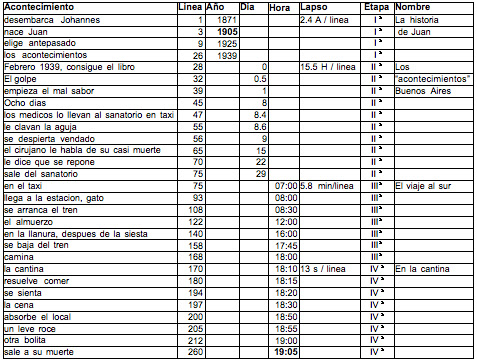
En la tabla que sigue, tenemos las medidas hechas:
En la primera columna, los acontecimientos descritos pos Borges.
En la segunda columna, el numero de orden de la linea en el texto, el tiempo de coordenada o tiempo fiducial, experimentado por el lector.
Luego, en tres columnas distintas, el año, el dia o la hora del acontecimiento, el tiempo experimentado por Dahlmann o el tiempo verdadero del mundo que ha creado Borges. Hay tres columnas porque los acontecimientos toman lugar a ritmo de años, dias, horas o minutos segun la etapa en que estamos.
En la siguiente columna tenemos el “lapso” calculado: el tiempo verdaderamente pasado dividido por el tiempo de coordenada del lector, es decir, el numero de lineas traspasado.
En la columna final, la etapa a que he asignado el acontecimiento.


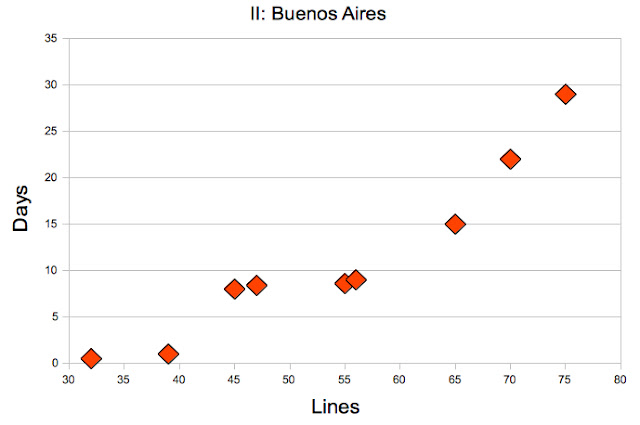
Las etapas quedan obvias en la tabla si se fija en el lapso, y para ver las variaciones dentro de cada etapa vamos a dibujar el tiempo verdadero contra el número de linea, separando los dibujos según etapa.

Cómo entender los dibujos: Cada punto representa un momento cronológico en la narrativa del texto y el numero de la linea en que aparece. Una pendiente alta entre dos puntos indica que ha pasado mucho tiempo en pocas lineas. Por ejemplo: En la primera linea, el abuelo alemán desembarca en Buenos Aires en el año 1871, y tan solo 26 lineas despues, empiezan los acontecimientos del año 1939 y han pasado 68 años muy rapidamente para el lector.

En contraste, una pendiente baja entre dos puntos indica poco paso de tiempo, a lo mejor es un dialogo, el ritmo de escribir el cual es casi igual que el ritmo que lleva la conversacion. O tal vez es una seccion descriptiva como al principio de la cuarta etapa, entre que Dahlmann entra en la cantina y se seinta a cenar, traspasan probablemente cinco minutos pero Borges toma 24 lineas para describir el local, la reaccion de Dahlmann al proprietario de la cantina, y para describir los otros huespedes desde el punto de vista de Dahlmann.

Una pendiente negativa hubiera indicado una vuelta hacia el pasado, quizas una escena de memoria o un viaje en el tiempo. Hay pequeños momentos de recuerdos, pero son demasiado cortos para que nos molesteos en contarlos. Asi que la narrativa de El Sur sigue monotona en tiempo.

En el primer grafico, he dibujado el lapso, el ritmo del flujo del tiempo (bueno, el logaritmo de ello) contra el numero de linea en el texto. El lapso se puede entender como la derivada del tiempo cronologico con respeto al numero de linea. Aqui, se ven las cuatro etapas claramente. (Para decidir la frontera entre las etapas 3a y 4a, he usado acontecimientos significativos del texto.)


Primera etapa:

Aqui vemos por primera vez un truco que emplea Borges para distorsionar el tiempo dentro de cada etapa: despues del comienzo de la etapa, el tiempo verdadero fluye cada vez mas lentamente, mas que simplemente contar los hechos, Borges empieza a contar la historia.

Segunda Etapa “En Buenos Aires”:


El efecto de la distorsión en esta epoca es mas sutil. Primero, ocho días pasan en tan solo 6 lineas (#39-#45), relativamente rapidamente. Sin embargo, Borges dice que Dahlmann los sintio pasar muy lentamente: “Ocho días pasaron, como ocho siglos.”. Extraña que en ocho siglos haya pasado tan poco. Se debe decir mejor que ocho días pasaron como ocho segundos: no pasó nada, y ocho segundos es del orden del tiempo que se tarda en leer 6 lineas. Luego, el tiempo que Dahlmann pasa en la cama en el sanatorio sí que pasa muy lentamente, Borges utiliza ocho lineas (47-55) para describir los pensamientos y sentimientos de Dahlmann y lo que le hacen en el sanatorio, es una pausa introspectiva y descriptiva. Al final, pasamos otra vez a una fase narativa donde los hechos y el tiempo pasan a cierto ritmo seguido.

Tercera (“El Viaje al Sur”) y Cuarta etapas:


Entre las primeras tres etapas hay dos transiciones, y los dos son descontinuos; el lapso, o visualmente la pendiente del gráfico, da un salto. (Eso indica, matemáticamente, que el tiempo coordenada es mala.) Sin embargo, entre la tercera y la cuarta etapa la transición es mucho mas suave, como se ve en el dibujo de arriba. Otra vez, al final de la etapa tercera, se baja la velocidad del cuento, analogo a la bajada de la velocidad del tren en que viajaba Dahlmann a la velocidad de su caminata hacia la cantina.

El patrón en las dos últimas etapas es el mismo. Hay tres fases, en la primera fase el tiempo pasa muy lentamente, hay mucho que describir o contar, o a lo mejor Borges relata un dialogo. En la segunda fase el tiempo pasa muy rapidamente, por ejemplo, en la tercera etapa, Dahlmann come, toma una siesta y se despierta ya con el tren casi en el destino. Es casi como si Borges tuviera impaciencia de llevarnos a la ultima fase, donde otra vez, muchas cosas pasan, y hacen falta muchas lineas para un periodo corto de tiempo.

(El análisis de las pistas que da Borges sobre la “verdadera” realidad, de lo que realmente pasaba a Dahlmann, lo dejé a los alumnos de Literatura Española 5 AP Honors de la Sra. Montague de Nichols Academy en Buffalo, NY. A cambio, les presenté este análisis.)

Cuarta etapa “La Cantina”:


El salto en tiempo en medio de esta etapa es entre el momento en que decide cenar y el momento en que acaba de cenar y empieza a absorber el local, y se pasan en muy pocas lineas. Depsues de esto, pasan muy lentamentes las cosas, a mi me dio la sensación de movimientos muy viscosos, como si tomaran lugar en miel. Los últimos segundos y muchas lineas, los pasamos en la cabeza de Dahlmann.

Borges utiliza muchos círculos: el taxi que aparece dos veces, el patron de la cantina que se parece al hombre del sanatorio, la clavada de la aguja. Es justo entonces, que la vida de Dahlmann acaba a las 19:05, que corresponde al probable año de su nacimiento, 1905, y tambien es el año en que Einstein publicó la Teoría Especial de la Relatividad.

Y por fin, lean “Pincher Martin” de William Golding.

A Mechanic Does The South

A mechanic does Borges' The South (Translated from my Spanish, so take your chances with the English.)

I apologize to readers who come by car, I'm a mechanic not of cars but of the quanta.

The influence of quantum mechanics in The South, by Jorge Luis Borges

Read the text before reading the essay.
The South in English

The work of writer Jorge Luis Borges has been analyzed from various points, including the mathematical. His magical-realist tale The South is a very frequently assigned text for students of literature in Spanish. Borges wrote the story before the year 1944, by the time modern physics (Einstein's relativity and quantum mechanics of Schrödinger, Heisenberg, Bohr, Einstein, Dirac and others) and was in full flower and its ideas (especially those of the relativity of time and probabilistic evolution) had come to form part of the minds of artists and common people. (Of course Foucault may view this as causality violation.)

What is it that comes to mind when you mention quantum mechanics? Emotionally, fascination and fear, and then thoughts about the Schrödinger cat in a box, the separation between the observer and the observed, the effect of interaction between them (an "experiment"), the probabilities and the uncertainty principle of Heisenberg. You see these themes in the text.

The cat in the cafe in the train station, "the magical animal." Its presence in the text serves to underline the unreality of the situation of Dahlmann, that he is no longer part of the world ("this contact was illusory") and as a subtle reminder of Schrödinger's cat.

A quantum system can be a combination of states that are distinguishable: for example the system of a radioactive atom can be in a mixed state of pure intact and pure decayed,
for example: | atom> = (0.87) | intact> + (0.71 + i 0.71) (0.5) | decayed>
with complex amplitudes whose magnitudes are the probabilities of finding the atom intact or decayed atom when we do an experiment. (In the above case when we make the experiment on an identical set of atoms on the average 75% will intact and 25% will have decayed.)
However, an animal, a macroscopic system, can only be alive or dead, we are disturbed about the state of cat as a complex combination of live and dead states, for example, what would our representation of the cat state as:
 | Cat> = (0.87) | alive> + (0.71 + i 0.71) (0.5) | dead> mean?
Normally we do not have to take issue with this since we can not put a cat in such a mixed state.

The trick is to couple the macroscopic state of the cat with the quantum state of a system. In the Schrödinger gedankenexperiment, we put a cat inside a closed box with a fissible atom and a radioactivity detector which opens a bottle of poison gas when it detects the splitting of the atom, which yields the coupling of corresponding states of the atom and the cat.
When we start the experiment the atom is in a pure state of not having fissioned. Based on the dynamics of the nucleus, it immediately begins to evolve into a mixed state of pure intact and pure decayed over time, and the amplitude of the decayed state increases to 1 with an exponential decay. The cat begins alive and in a live state. After a while, both the atom and the cat will be in states similar to those above.

Analogously, after being injected in the hospital, to us Dahlmann is a mixed state of living or dead / dreaming feverishly. Our doubts about Dahlmann's state evolve towards certainty of his death. But at an intermediate point, is he alive or dead?

The separation between observer and observed: Dahlmann feels "like they were separated by glass." If there are two beings, either can be the observer and the other the observed. The cat may be there to test the state of Dahlmann. As meta-observers, we do not know if the cat has felt the caresses of Dahlmann, and we continue with questions about the state of Dahlmann.

The effect of experiment: In classical mechanics, if we know the dynamics of a system, the observations after an experiment to measure, for example, the position and velocity of a thrown ball, allow us to know both the past and the future state of the system. In quantum mechanics, to the comtrary, unless we know the previous state the experiment only allows us to know the future state and generally only probabilistically predict the outcome of a future experiment. (Using Bayesian analysis on an ensemble one may deduce something of the previous state.) In contrast, in The South, in the hospital, "a masked man stuck him with a needle." We knew the prior state Dahlmann - wounded and sick. But for readers, the injection causes the start of the uncertainties, the bifurcation of the state between dead and alive. Furthermore, the dynamics of the story cause more and more separation between the two directions and more uncertainty.

Uncertainty: There is uncertainty about the state of Dahlmann until the end of the story, but I don't see that is shaped according to the Heisenberg principle.

Probabilities: We can argue, and the students did so very much, the chances of this dead or alive Dahlmann during the second part of the story. But what distinguishes quantum mechanics is not classical stochasticity and the probability distribution of the state - such as the classical mechanics we have in the statistics - rather the quantum state is a distribution of complex amplitudes, whose absolute value is the probability distribution, and interference between the amplitudes leads to the more dramatic effects of quantum mechanics (eg Young's experiment with ultra-low intensities of light).

I remind you also that Borges, like physicists, is very fond of symmetries. Borges and reality like slight anachronisms, and Borges anticipates that the issue of possible violation of causality in quantum mechanics: the Einstein-Podolsky-Rosen paradox and corresponding gedankenexperiment were described only in the 1950s.

Un Mecanico Cuenta Borges

Un mecánico cuenta El Sur de Jorge Luis Borges

Pido perdon a los lectores que vienen en coche, no soy un mecánico del coche sino del quantum.

La influencia de la Mecánica Cuántica en El Sur, de Jorge Luis Borges

Leen el texto antes de leer el ensayo.

La obra del escritor Jorge Luis Borges ha sido analizada de diversos puntos, entre ellos el matemático. Su cuento mágico-realista El Sur es un texto asignado muy frecuentemente a los estudiantes de la literatura en Español. Borges escribió el cuento antes del año 1944, para cuando la física moderna (la relatividad de Einstein y la mecánica cuántica de Schrödinger, Heisenberg, Bohr, Einstein, Dirac y otros) ya estaba en pleno aflorecimiento y se habían metido las ideas (sobre todo la de la relatividad del tiempo y la de la evolución probabilística) en las mentes de los artistas y del pueblo vulgar. (Claro, puede que Foucault lo vea como una violación de la causalidad.)

¿Que es lo que viene a la mente vulgar cuando se menciona la Mecánica Cuántica? Emocionalmente, fascinación y miedo, y luego los pensamientos sobre el gato de la caja de Schrödinger, la separación entre el observador y lo observado, el efecto de una interacción entre ambos (un “experimento”), las probabilidades y el principio de incertidumbre de Heisenberg. Se ven estos lemas en el texto.

El gato del café de la estación del tren, “el mágico animal”. Su presencia en el texto sirve para subrayar la irrealidad de la situación de Dahlmann, que el ya no forma parte del mundo (“aquel contacto era ilusorio”) y como un sutil recordatorio del gato de Schrödinger.

Un sistema cuántico puede estar en una combinación de estados que son distinguibles: por ejemplo el sistema de un átomo radioactivo puede estar en un estado mixto de puro intacto y puro fisionado, (pero no puro fumado)
por ejemplo: |átomo> = (0,87)|intacto> + (0,71 +i 0,71)(0,5)|fisionado>
con amplitudes complejas cuyas magnitudes son las probabilidades de encontrar el átomo o intacto o fisionado cuando hagamos una prueba. (En el caso de arriba cuando hagamos el experimento sobre un conjunto de átomos idénticos en el promedio saldrán 75% intactos y 25% ya fisionados.)
Sin embargo, un animal, un sistema macroscópico, solo puede estar o vivo o muerto, nos perturba hablar del estado de gato como una combinación compleja de estado vivo y estado muerto, por ejemplo, ¿que significaría nuestra representación del estado de gato como:
|gato> = (0.87)|vivo> + (0.71 +i 0.71)(0.5)|muerto> ?
Normalmente no nos tiene que dar dolor de cabeza este tema puesto que no podemos poner un gato en tal estado mixto.

El truco consiste en acoplar el estado macroscópico del gato con el estado cuántico de algun sistema. En el gedankenexperimento de Schrödinger, metemos un gato dentro de una caja cerrada con un átomo fisíl y un detector de radioactividad que abre una botellita de gas venenoso cuando detecta la fisión del átomo, lo cual consigue el acomplamiento de los estados correspondientes del átomo y del gato.
Cuando empezamos el experimento el átomo está en un estado puro de no haber fisionado. Por la dinámica del núcleo, inmediatamente empieza a evolucionar al estado mixto de puro intacto y puro fisionado y a lo largo del tiempo la amplitud de la parte fisionada aumenta con un decaimiento exponencial hacía uno. El gato empieza vivo y en un estado vivo. Después de un rato, tanto el átomo como el gato van a estar en estados parecidos a los de arriba.

Analógicamente, después de que le pinchan con la aguja en el sanatorio, en nuestra representación Dahlmann está en un estado mixto de vivo o muerto/soñando febrilmente. Su estado y nuestra certidumbre sobre ello evolucionan hacía su muerte segura. Pero en algún momento dado, está vivo o muerto?

“r”, o la separación entre observado y observador: Dahlmann siente “que estaban como separados por un cristal”. Si hay dos seres conscientes, cualquier puede ser observador y el otro observado. El gato puede estar allí para probar el estado de Dahlmann. Como meta-observadores, nosotros no sabemos si el gato ha sentido las acaricias de Dahlmann, y seguimos con dudas sobre el estado de Dahlmann.

El experimento: En la mecánica clásica, si sabemos la dinámica de un sistema, las observaciones después de un experimento de medir, por ejemplo, la posición y velocidad de una pelota tirada, nos permiten saber tanto el pasado como el futuro estado del sistema. En la mecánica cuántica, a cambio, si no sabemos el estado anterior ya, el experimento solo nos permite saber su futuro estado y en general predecir solo probabilísticamente el resultado de un futuro experimento. (Usando analysis de Bayes sobre un conjunto de experimentos se puede saber algo del estado anterior.) Al contrario, en El Sur, en el sanatorio, “un hombre enmascarado le clavó una aguja”. Sabiamos el estado de Dahlmann anterior – herido y enfermo. Pero la clavada causa en los lectores el comienzo de las incertidumbres, la bifurcación de su estado entre muerto y vivo. Además, la dinámica del cuento causa cada vez mas separación entre los dos rumbos y mas incertidumbre.

La incertidumbre: Hay incertidumbre sobre el estado de Dahlmann hasta el fin del cuento, pero no veo que tenga la forma segun el principio de Heisenberg.

Las probabilidades: Podemos discutir, y los alumnos lo hicieron mucho, las probabilidades de que este muerto o vivo Dahlmann durante la segunda parte del cuento. Pero lo que distingue a la mecánica cuántica de la clásica no es la estocacidad y la distribución probabilística del estado – esas ya la tenemos en la mecánica clásica estadística – sino que que el estado es una distribución de amplitudes complejas, cuyo valor absoluto es la distribución de probabilidades, y la interferencia entre las amplitudes da lugar a los efectos mas espectaculares de la mecánica cuántica (por ejemplo el experimento de Young con intensidades ultra-bajas de luz).

-->Les recuerdo tambien que a Borges como a los físicos les gustan mucho las simétrias. A Borges como a la realidad, le gustan las leves anacronísmos, y en eso Borges anticipa la cuestión de la posible violación de causalidad por la Mecánica Cuántica: la paradoja de Einstein, Podolsky y Rosen y el corespondiente gedankenexperimento se describió solo en los 1950s.

Monday, June 11, 2012

India's First RAAM Rider

Samim Rizvi is India's first rider in the RAAM.

My sister, Divya, is in California, acting as support crew for him. This is information and some background that the team has sent. (By the way, Team Red, comprised exclusively of riders with diabetes, was first in 2010!)

Samim Rizvi is the first and only Indian to cycle the Race Across AMerica or RAAM, 5000 km in 12 days. He is in the solo category, I believe less than 200 people have completed this within the time frame. This is his 3rd attempt, first time he got sick on the 4th day and had to abort. Last year, his second attempt, he completed just in time but team, traffic etc penalties put him 40 mins out of time. The last time his attempt was bogged down by lack of sufficient funds and much of his time was wasted on the road. It is the same situation this time around, but we don't want his endeavour to suffer for it and an RV has been hired so he can have a place to sleep on the road and hot food etc as required.

During his previous two attempts Samim was often sleeping on the side of the road, since the availibility of convenient motels along the route did not mesh with his cycling schedule, tiredness or sleepiness. His nutrition depended on the team's being able to find adequate restaurants along the route, or sandwiches, as opposed to the healthier, hot food they plan to prepare for him this year in the RV.

The race is effectively a massive time trial – once the clock starts it is never shut down or paused until you finish – the rider sleeps or eats on his or her own time.

All the crew are volunteers, and his manager, Kavitha Kanaparthy and her parents are spending their personal money to make this happen. But that leaves little room for sufficient spares etc.

Cycling, like a lot of sports that need expensive equipment is in a nascent stage in India, and pioneering efforts such as Samim's come at huge personal costs. They will hopefully pave the way for more recognition for the sports in coming years.
If you know people who would like to pitch in with donations of funds however small it would be most appreciated. Do ask them to forward to others too. The links to the donations page, his website and the RAAM website to follow his progress are below.
 
We welcome and appreciate people's good wishes and words of support, and look forward to receiving yours.

Wednesday, May 23, 2012

Postscript to "Nature in Art"

In response to various comments from both close friends and from people who've known me for a couple of hours, which were along the lines of
A not-so-young physicist, un Indio
Posted on his blog about VIBGYOR.
"The passion is clear,
The physics, 'No fear!',
But the tone, ahh that is a failure!"


After what RS, ARM, DST, SP, AP, SK, PSK, JB etc have put me through over the last few weeks in the "Home Truths Dept.", I think a Maoist re-education camp will be a piece of cake!


...


One of the above friends: "Do you acknowledge that you have been personally responsible for suppressing millions of hard-working peasants?"


RST: "Yes."


Same friend: "Wait, you've already self-confessed? I don't get to torture you?"


RST: "The other friends in the list above have said pretty much the same thing about me, so it must be true."


Some friend!: "So what are you going to do about it?"


RST: " 'Do about it?' ? What do you mean? That would require me to be different from what I am! ... Oh, I see your point!"


...

So here goes: I want that post to be seen as a learning opportunity about observing nature, not art criticism nor artist criticism. To be very very explicit: The artistic representations aren't incorrect representations of nature - they don't have to be, reality is not the only domain of art. They're just not realistic/scientific representations of nature. True, which doesn't prevent them from sometimes being spot-on in capturing some essence of nature.

In exchange, I would like acknowledgment that
1)  scientists can appreciate beauty in nature, in spite of "having an equation for it", and that
2)  scientists can appreciate art, in spite of being very analytical (Read any art reviews lately?).

In that post "wrong" should be interpreted not as a commentary on the moral nature of the artist, but rather as "observationally incorrect representation of nature, but of course the artist has artistic license to do what she or he wants, just use this as an excuse to step outside and look, really look, at a rainbow!"


A painter friend of mine in Madrid (Javier F L)  put it best when I asked him why he painted, "I paint because it gives me an excuse to gaze for long periods of time." I couldn't disagree less about why I do science, or data analytics for that matter. (This isn't helping me get a job, is it?)

Anant Kiran

Caught in the endless sunray,
          a droplet of rain.
   It glows, or is consumed.

Monday, May 21, 2012

Annular Solar Eclipse

Maya, Elsa and I drove to Pleasanton, from where we carpooled with Sudhir and his family to Reno. When we got to the Univ. of Nevada, the grassy are was replete with a wide variety of viewing instruments, ranging from a pinhole camera kit, through home made wooden binocular stands to 8" telescopes with motors and computerized drives. A very large number of people had shown unprepared and queued up for the solar viewing glasses that someone was selling for $10 apiece. Just for comparison, the #14 welders' glass cost me $3 apiece.

Inspired by TIEcon2012, I saw a business opportunity and made a hole bunch of money selling pinholes for $5 each (cards not included).

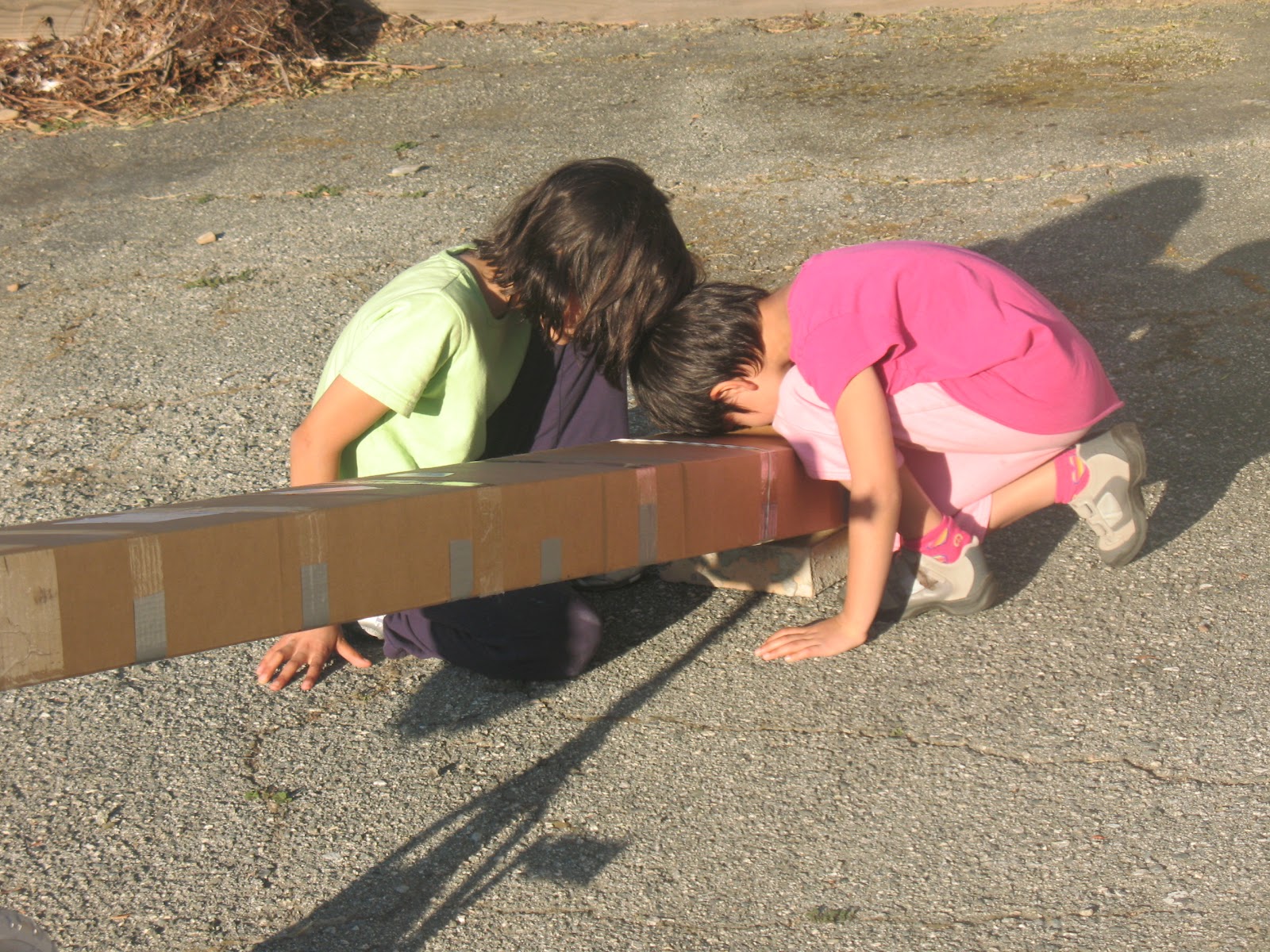
The atmosphere was festive, most people happily sharing their viewers and explaining the construction to others. My 7' long cardboard box, which could have housed a family of four squatters in Mumbai, drew a surprising lot of attention! Here are a few pictures, not very good ones, but perhaps some of the people who I met there will send me copies. Maya and Elsa don't appear in any of the photos because they took full advantage of their unstructured learning opportunity and with their new friends Rukmini and Ila ran around the crowd with their welders' glass and solar viewing glasses.

Woman with eclipses on her face through her straw hat.

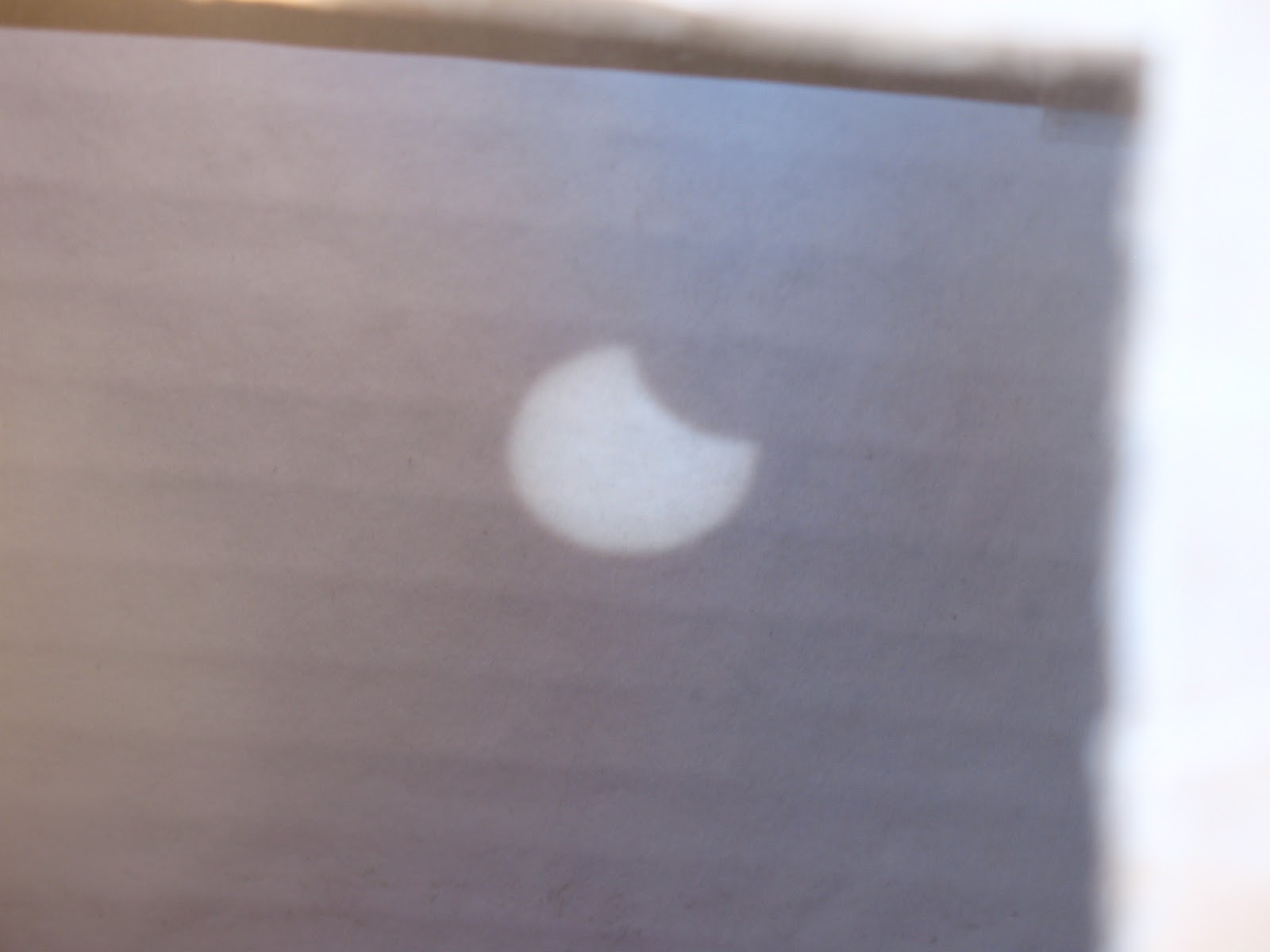
View in my pinhole camera, a few minutes after the start

A telescopic projector in which you could see the sunspots.

Der Sonnenteleskop

Photo through #10 welders' glass

Progressing.

My telescope projector. Is that a cloud in the sky?

There were expressions of disappointment all around, but look at how beautiful the cloud is!

15 minutes before maximum.

The cloud moved aside just in time.

Add caption

Saturday, May 19, 2012

Sunspots on screen

See the initial post.

It took a little bit of work and twiddling with the cheapy $20 telescope ( which is probably an excellent seismometer since it shakes with my heartbeat if I am within 5 feet of it!).

Since a telescope is designed to focus a virtual image on your retina with the help of a third lens (your cornea), in order to use it as an effective real image projection device (without setting the screen on fire!) the eyepiece has to be removed completely and held just outside the tube.

 I've just realised that the 90 degree reflector for the eyepiece may give me that added distance!

Cut and install a screen around the objective side of the telescope to provide a dark back ground for the sun's image. Note that the spotter scope is rendered useless.

So you can insert a long tack or pushpin from the back of the screen to use as an aid in alignment.

Or just use the shadow of the body of the telescope. In the following photo the telescope is NOT aligned.

Ready for the ...
... lead astronomer.
You can see the sunspot groups: a streaky one angled towards 630, at 9 o'clock, half way out, and a second one at 8 o'clock about 2/3rds of the way out.

Since this image is taken at sunset, in this photo the sun's North pole is at about 9 o'clock, as is confirmed by the rotation of the sunspots that Maya and I have observed over the last two days.

In the first observation two days ago, the lower sunspot was just above the 9 o'clock radial, both were in the top left quadrant.

Not a bad hack!

Friday, May 18, 2012

Solar Eclipse Preparation

I am planning to drive with Maya and Elsa to Reno, NV to view the annular solar eclipse on May 20th.

Here are a few useful links:
Tips on preparation
simplified eclipse path
make a pinhole camera (see my bottom end modification to eliminate excess ambient light)
optical projection (place a sunglasses lens over the objective to keep things cool)
simulation of view from bay area at maximum
another chart

Photo of real image of sun in 7' pinhole camera, with large hole cut out of bottom of tube. Note the faintness of the image due to excess ambient light compared to small amount entering pinhole.

Photo after modification of the camera - a small, angled viewing aperture. Note the increase in contrast.

The modification.
I am going to add an additional screen on the side of the tube with the viewing aperture. The viewing aperture can be made smaller as well.

The complete pinhole camera ...

... being tested rigourously.

Taking turns.

Direct photo of sun with a 16X zoom digital camera ...
AND a #14 WELDERS' GLASS.

Do NOT point your camera directly at sun, you may burn out your CCD (as opposed to just the negative!).

Do NOT look directly at sun without a #14 welders' glass.

TRAIN your kids to use it: look down, glass to eyes, then raise head with glass and locate sun (not easy!). Look down again, then remove glass from face.

Looking at the sun with the #14 filter through a pair of binocs, two groups of sunspots are readily visible. Over one day, they've rotated in the RHScrew direction about the Solar North pole (approximately the same as earth's), meaning, at sunset, in the West, they've dropped down across the face of the sun.

Please leave other relevant useful links as comments.

See the follow-up with the sunspots.